
We've had a busy summer building a better AIR Platform. We deepened the capabilities you already use and added new ones that open up analysis you couldn't run before: a fuller view of a company's financials, sharper notifications, and an early look at bringing your own credit model into AIR.
The thread running through all of it is the same one we keep pulling on. The hard part of credit was never the judgment — it's everything that has to happen before you get to exercise it. Finding numbers for a name that barely reports. Noticing that something moved on a company you haven't opened in six weeks. Reconciling your team's scorecard, which lives in a spreadsheet somebody owns and nobody maintains, against data that went stale a quarter ago. None of that is analysis. All of it is where the time goes, and all of it is where the misses happen. This release is about taking three of those problems off your desk.
Financials Builder: A Credit Read on Names That Barely Report
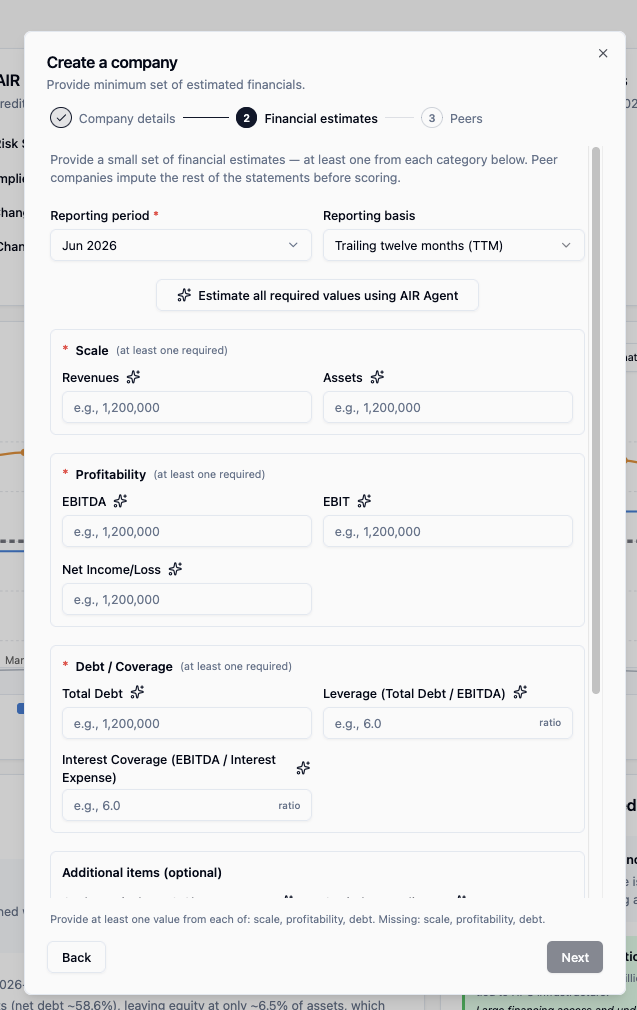
This one matters most if you work in private credit, where the honest answer to "what are this company's financials?" is often, if your lucky, "we have a few numbers and a management deck." You still owe someone a view on the credit. Financials Builder now extrapolates a full set of statements from a limited set of inputs you provide, plus a set of peers, and gives you an indication of where the name falls from a credit risk perspective.
You supply at least one value from each of three categories — scale, profitability, and debt or coverage — and the peer set imputes the rest of the statements before scoring. If you'd rather not hunt for even that much, AIR Agent will estimate the required values for you and let you correct them. The point isn't to pretend you have audited financials. It's to get a defensible, comparable read on a name that would otherwise sit in your book unrated.
Notifications: The Moves Come to You
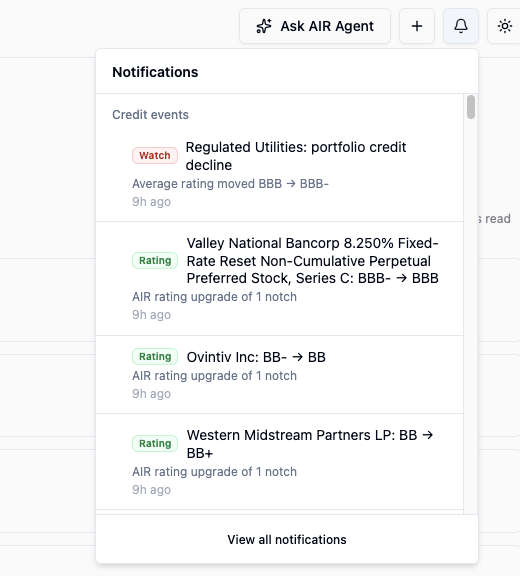
The platform is deep, and you can't click through to every company you care about every morning. Notifications are how we surface the changes that would have justified the click. You'll see a bell in the top right with a red dot on it when something has moved: deterioration or improvement in AIR implied ratings, and new financials landing on names you follow.
A single-notch upgrade on a name you already know well is a nice-to-have. The one that earns the feature is the portfolio-level line — average rating on a sector book drifting from BBB to BBB- while nothing in particular looked alarming on any individual name. That is the kind of drift nobody goes looking for, because there's no obvious day on which to look.
Bring Your Own Scorecard
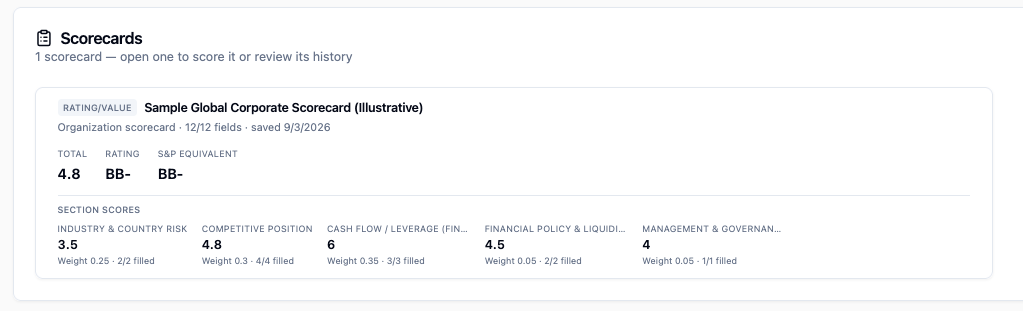
The big one, and the one we're most interested in your reaction to. You can now take your existing scorecard and build it directly into AIR — your factors, your language, your weights. It runs on our financials and our agent, with your analysts' judgment where judgment belongs, and produces a credit opinion framed the way your business actually thinks about the name.
What that replaces is the dozens of Excel files floating around every credit team, each one a slightly different vintage of the same model, each one only as current as the last person who remembered to update it. Built into AIR, the same scorecard becomes scalable, repeatable, and automated, and it reruns against the latest information rather than whatever was in the workbook the day it was saved.
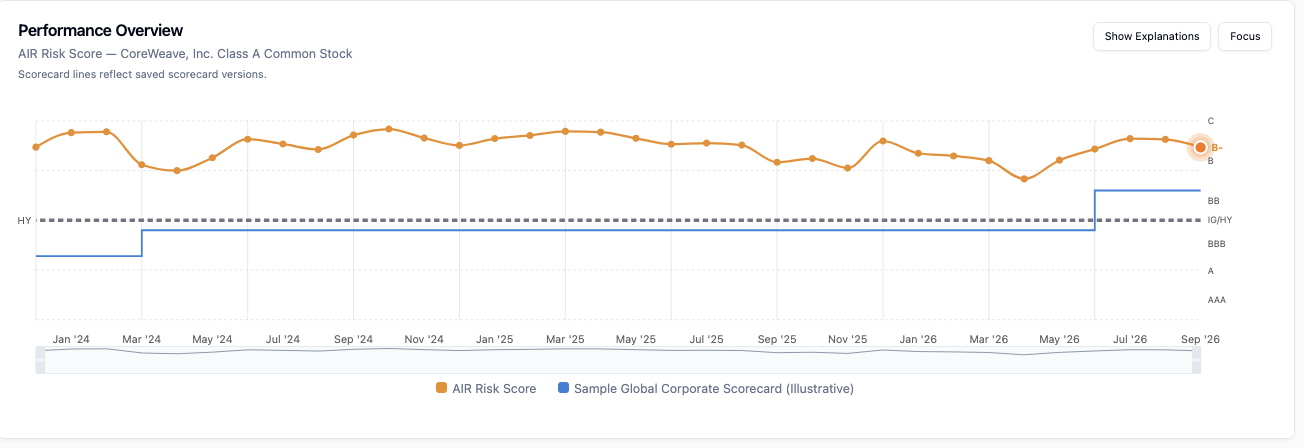
It also means your own model and ours can finally be read on the same chart. Below, a scorecard rating sits alongside the AIR Risk Score over the same period — where they agree, where they diverge, and when your framework moved relative to ours. That comparison is difficult to produce today and awkward to defend in committee when you do; here it's the default view.
This is an early look. If you want your scorecard running in AIR, start with your account team — they'll walk you through what it takes to get yours built in.
Behind the Scenes
The rest is work you may never notice, which is usually the sign it went well:
- Financials you can interrogate. An improved viewing experience and better extraction from documents. Data quality flags call out significant changes in individual line items, and you can now see how a value was extracted or calculated by the AIR financials engine rather than taking it on faith.
- Cleaner public company data. Additional identifiers — CUSIP, ISIN, LEI — make names easier to find, and alternative names and tickers now resolve to the version AIR uses, so you stop landing on the wrong entity or none at all.
- A stronger MCP tool suite. Refinements so Claude, Copilot, and other third-party AI tools can take fuller advantage of AIR's intelligence when you call it from where you already work.
We'd love to walk your team through these new capabilities. Reach out to schedule a session and see how to get more value out of AIR today.