
Know the credit risk in the companies you depend on.
AIR flags deterioration in your customers, suppliers, and trading counterparties, public or private, months before agency ratings move, and shows how a shock spreads through them.
For credit and risk teams in energy, utilities, and corporates.
Track record
- Lead on agency rating downgrades
- 11mo
- Lead on bond & loan price collapse
- 6mo
- Corporate debt scored daily
- $11T+
Set limits and terms with confidence, and say yes to more business.
Predictive.
Specialized models flag a counterparty’s deterioration before it happens. Agency ratings react after.
Tighten terms, ask for collateral, or cut exposure in time.
11–12 months earlierEarly credit deterioration · Global bankSystemic.
One scenario across every customer, supplier, and trading counterparty, showing where exposure concentrates.
Find concentrations before they become losses.
Forward scenariosGeopolitical stress testing · U.S. energy companyFast.
Onboard or review a counterparty in minutes, public or private.
Approve good customers and suppliers sooner.
10× fasterCredit decisions · Credit manager · ~$20B AUM
A key supplier starts to slip. Two ways it plays out.
The signal
Without AIR
You hear when the agency downgrades, or payments arrive late.
With AIR
AIR flags it months earlier.
The analysis
Without AIR
Filings into Excel, if they exist, then an AI assistant. Days.
With AIR
Drivers, peers, and implied rating, ready, private companies included. Minutes.
Your exposure
Without AIR
No one knows which suppliers and customers share the exposure.
With AIR
One scenario shows every counterparty exposed to the same shock.
Different exposures. The same credit questions.
Energy & Utilities
Trading counterparties, offtakers, and project partners behind your supply agreements and long-term commitments.
Scenario examples: oil and gas prices, severe weather, demand shifts.
Corporates
The customers behind your receivables, the suppliers you rely on, and partners in major commitments.
Scenario examples: tariffs, input costs, a demand slowdown.
Relationships AIR assesses
- Customers
- Suppliers
- Trading counterparties
- Offtakers & PPA counterparties
- Partners, sponsors & contractors
- Guarantors, insurers & sureties
Understand the credit behind the relationship.
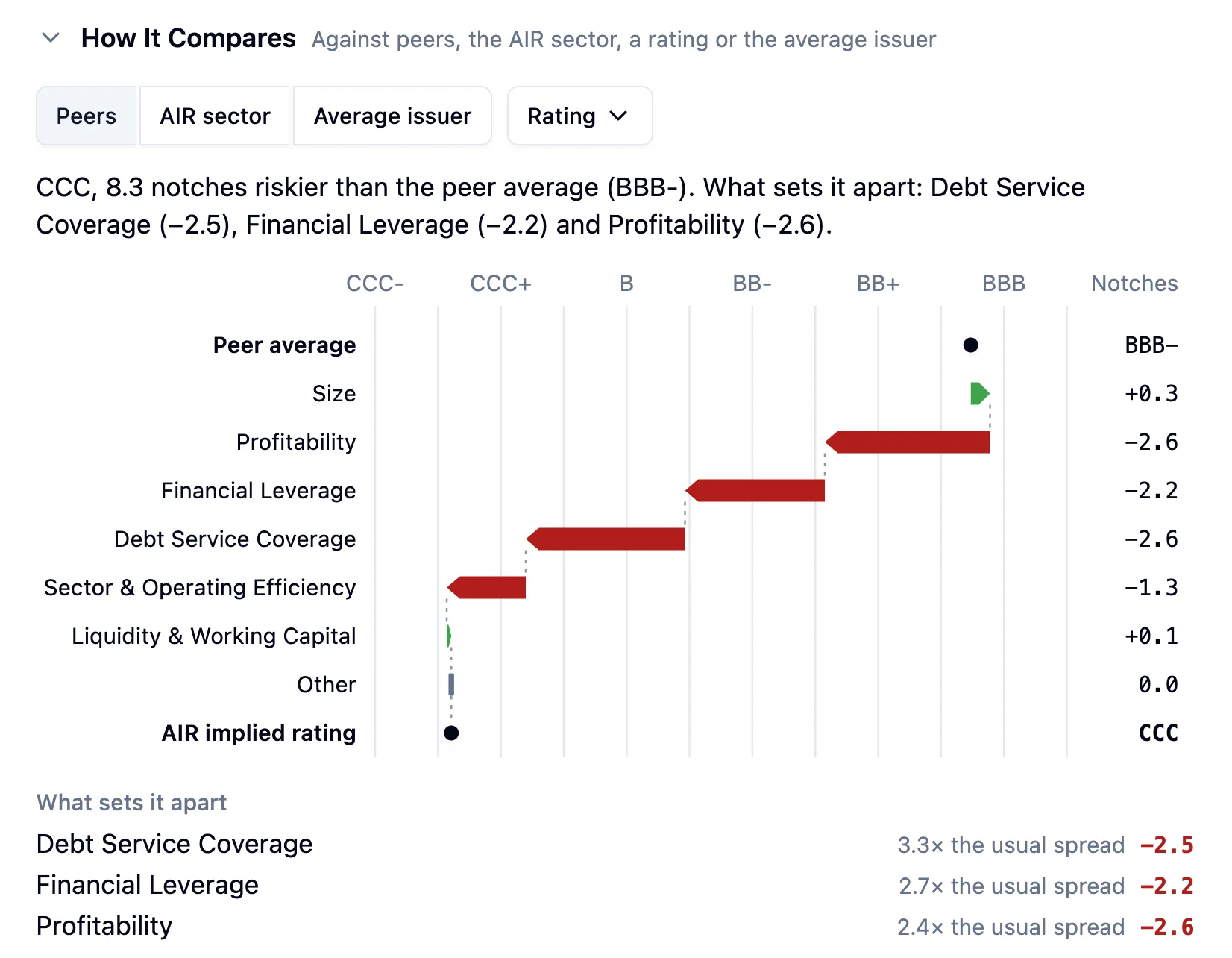
Public counterparties are already in AIR, with risk score, implied rating, drivers, and peers. For private ones, upload the financials you have or let Financials Builder estimate missing inputs.
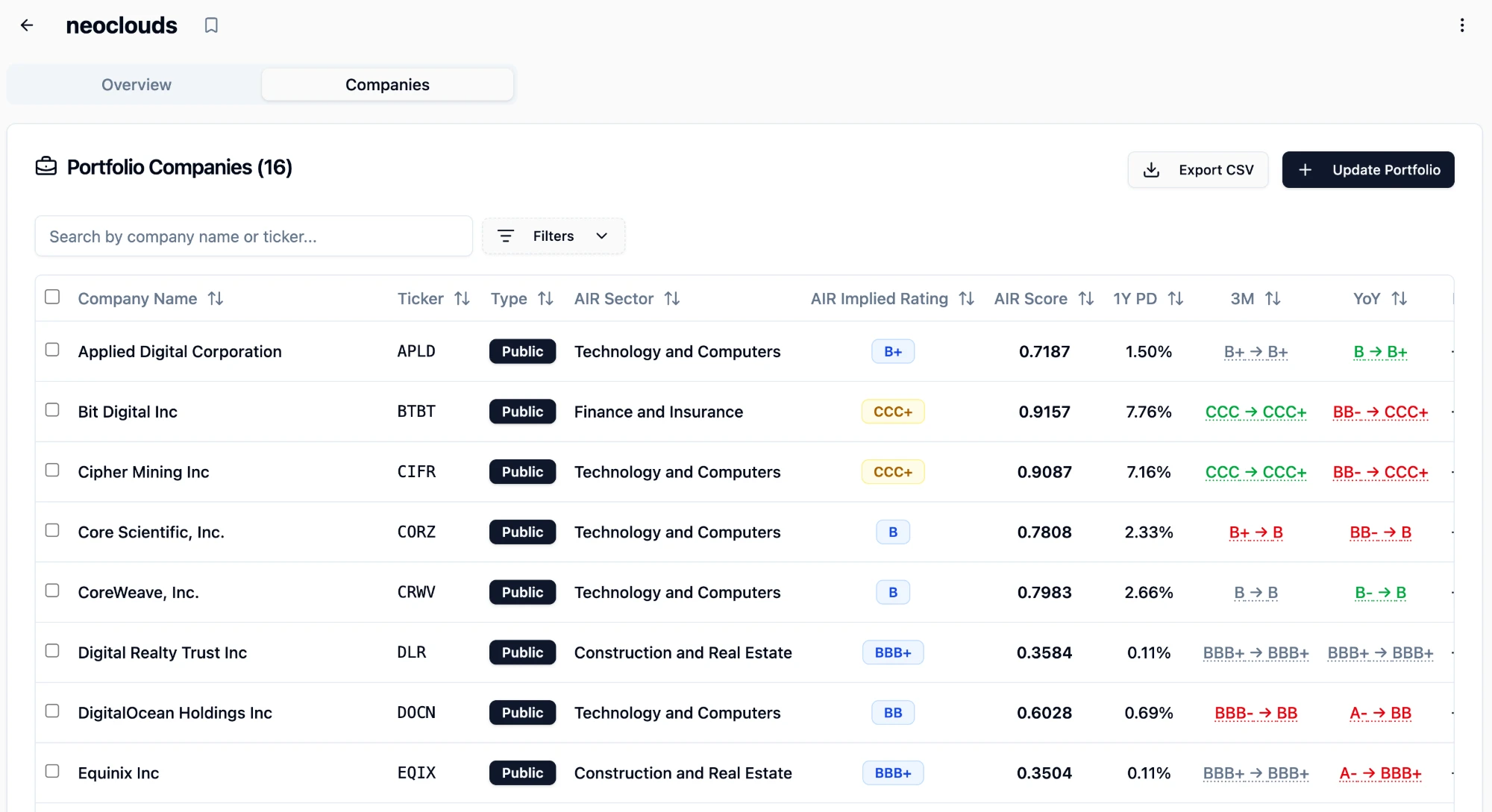
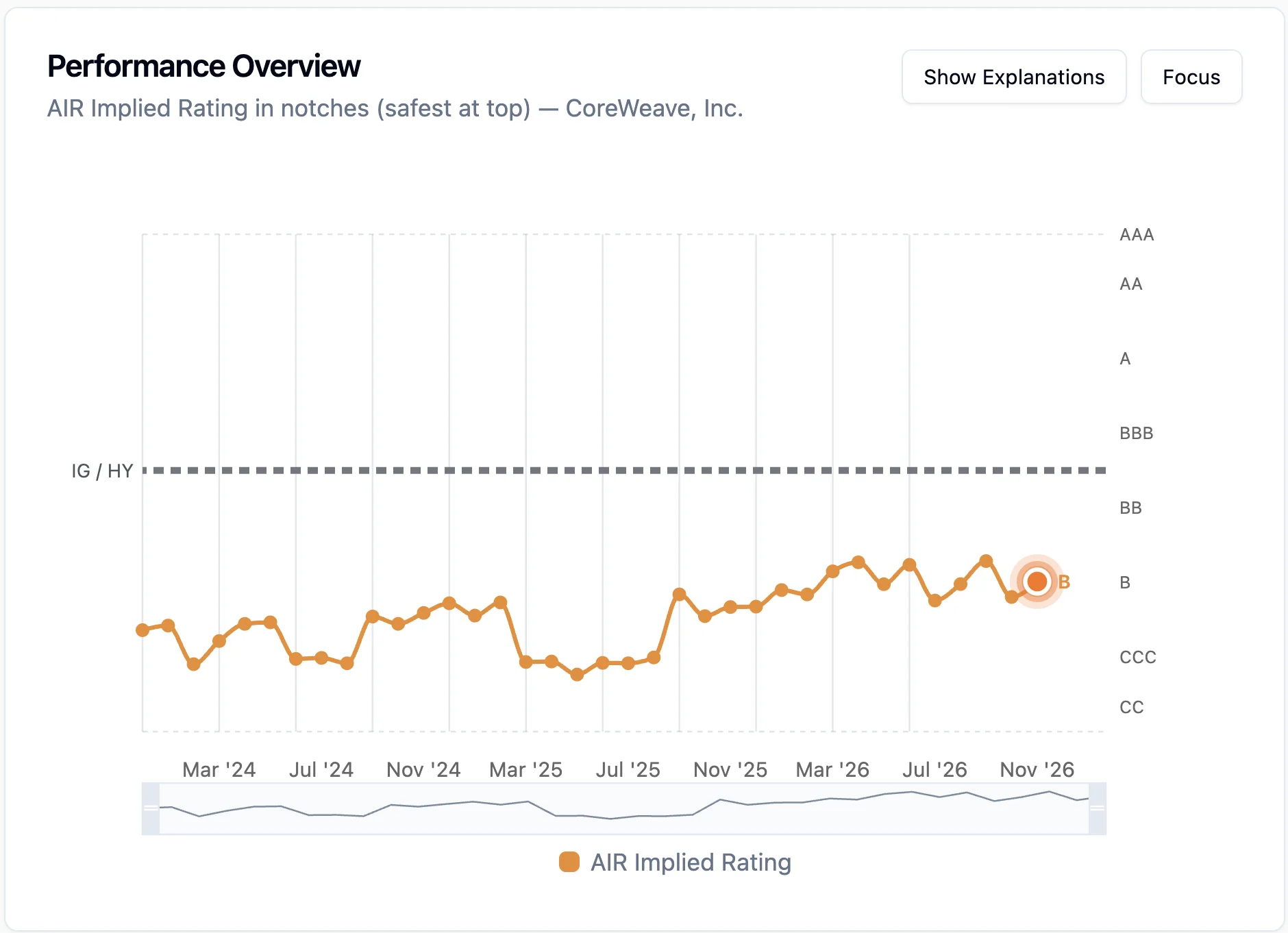
Catch deterioration before it reaches your receivables.
Daily credit signals, with alerts when implied ratings change or new financials arrive, and the reasons behind each move.
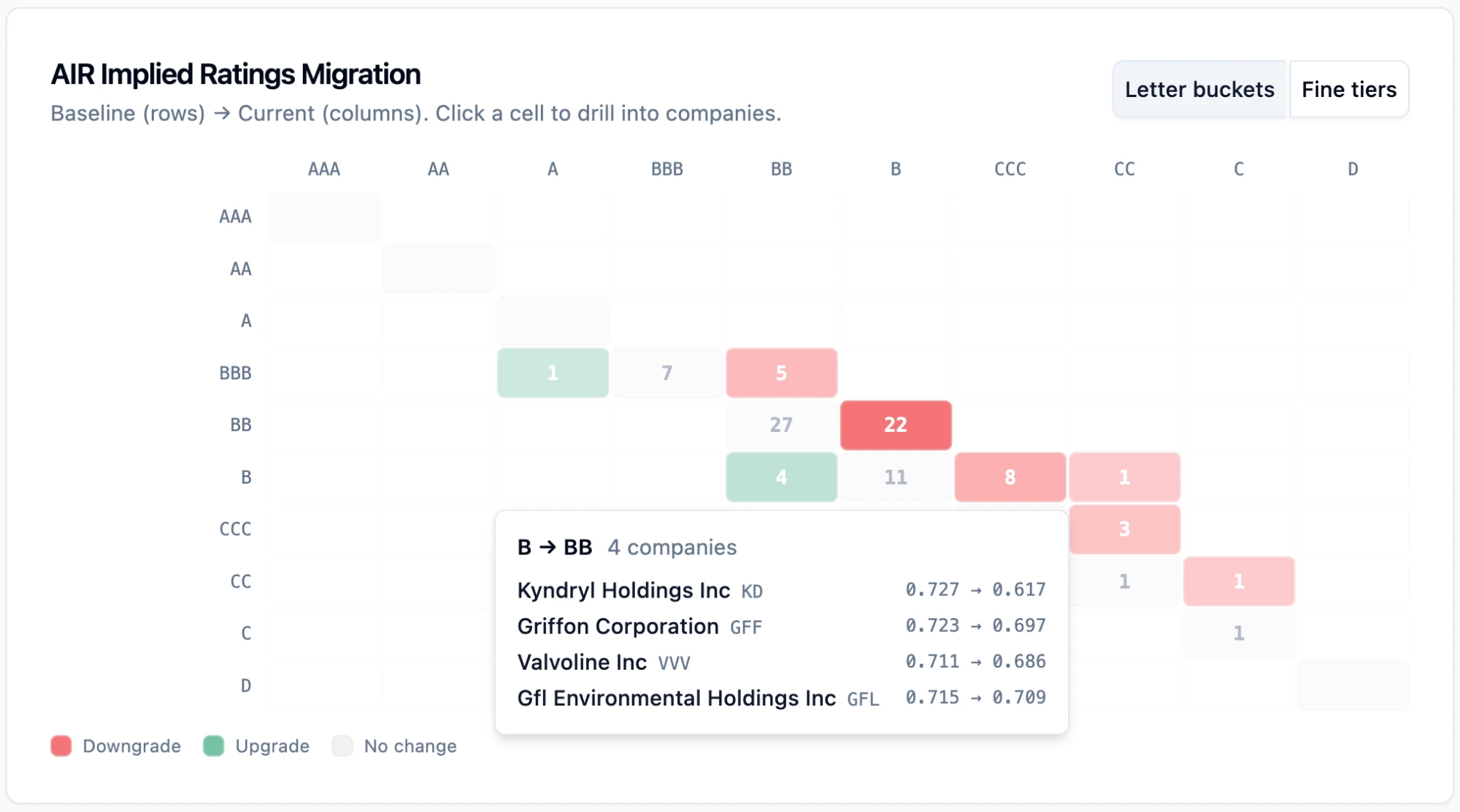
See which counterparties are most exposed to a shock.
Describe a commodity move, a tariff, or severe weather, run it across your whole book, and see where credit could change and why.
Counterparty credit questions, worked through.
Analysis of real companies, from early warning signs to how a shock spreads.
- AIR Research · Energy scenario
The credit impact of oil at $130 per barrel
Read analysison Substack (opens in a new tab) - AIR Research · Private company, estimated financials
AI Giants' Credit Reality Check
Read analysison Substack (opens in a new tab) - AIR Research · Scenario analysis
Can AI Bulldoze Caterpillar’s Credit?
Read analysison Substack (opens in a new tab)
What counterparty credit teams ask us.
Why not rely on agency ratings?
Agency ratings move after deterioration, and most of your counterparties, especially smaller and private ones, don’t have one. AIR flags deterioration about 11 months ahead of agency downgrades, for public and private companies alike, so you can tighten terms while you still have leverage.
Can’t we do this with Excel and an AI assistant?
They summarize what already happened. AIR’s deterministic models are trained to flag deterioration before it happens, give the same answer every time, and run one scenario across all your counterparties in minutes. Language models research and explain; they never set the implied rating. Read more in Why LLMs Should Not Make Credit Decisions (opens Substack in a new tab).
How does AIR compare with Moody’s EDF-X or S&P’s RiskGauge?
Both estimate company credit risk. AIR is built for how credit teams work now. Its specialized models flag deterioration early across public and private companies, and it adds what those tools don’t put in one place: scenarios across your whole book, links between counterparties, suppliers, and sectors, and AI agents in the workflow.
How does AIR work alongside D&B?
AIR complements D&B with specialized credit analysis: assessing a company’s financial strength, explaining the drivers, monitoring deterioration, and exploring scenarios. AIR can incorporate D&B data into that analysis, helping your team build on the information it already uses.
Can AIR assess private counterparties?
Yes, with the same methodology as public companies. Upload the financials you have, in PDF, Excel, or other formats, or let Financials Builder estimate missing inputs. Every figure is labeled, adjustable, and traceable.
Can we use our own credit model?
Yes, your team can bring its credit model into AIR and run it alongside AIR’s.
How does AIR protect our data?
AIR is SOC 2 Type II. Customer data is segregated by tenant and is not used to train AIR’s models. Security controls and supporting documentation are available for your team’s review. Trust & Security.
See your counterparties in AIR.
Share a few customers, suppliers, or trading counterparties, public or private, and AIR's team will walk you through their assessments, credit drivers, and scenarios.