
Understand the credit you own and the names you’re considering.
AIR flags deterioration in public and private issuers months before agency ratings move and prices fall, and shows how a shock moves through your portfolio.
For direct lenders, BDCs, CLO managers, and public credit investors.
Track record
- Lead on agency rating downgrades
- 11mo
- Lead on bond & loan price collapse
- 6mo
- Corporate debt scored daily
- $11T+
Find mispriced credit, and act before the market does.
Predictive.
Specialized models flag deterioration, from defaults to sharp spread widening, before it happens. Agency ratings react after.
Exit, hedge, or reprice before the drop.
6–12 months earlierEarly risk detection · CLO manager · ~$10B AUMSystemic.
One scenario across your whole portfolio, with concentrations by sector and theme, and credit themes in public markets before they reach private ones.
Size positions to what your portfolio can carry.
100% coverageBSL universe at scale · Asset manager · >$500B AUMFast.
Underwrite a new name or review a holding in minutes, public or private.
Move before the market reprices it.
10× fasterCredit decisions · Credit manager · ~$20B AUM
A holding starts to slip. Two ways it plays out.
The signal
Without AIR
You hear when the agency downgrades, after the bonds or loans reprice.
With AIR
AIR flags it months earlier, before prices fall.
The analysis
Without AIR
Rebuild the model in Excel, then an AI assistant. Days.
With AIR
Drivers, peers, and implied rating, ready, private companies included. Minutes.
Your portfolio
Without AIR
No one knows which holdings share the exposure.
With AIR
One scenario shows every holding exposed to the same shock.
Different investment strategies. The same credit questions.
Direct Lenders
Underwrite with the financials available, then monitor for the life of the loan.
BDCs
One consistent credit view across the portfolio, between reporting periods.
CLO Managers
Monitor BSL issuers between reviews, and see which names a scenario hits hardest.
Public Credit Investors
Explainable assessments, peer comparisons, and daily signals for HY and IG research.
Public and private companies. A consistent credit methodology.
Work with the financials available.
Reported financials for public companies come built in, or supply your own. Financials Builder estimates missing inputs, clearly labeled and adjustable.
Assess companies on a common basis.
The same methodology for public and private companies, so you can compare issuers across your universe.
Bring your own credit model.
Run your team’s credit model in AIR alongside AIR’s.
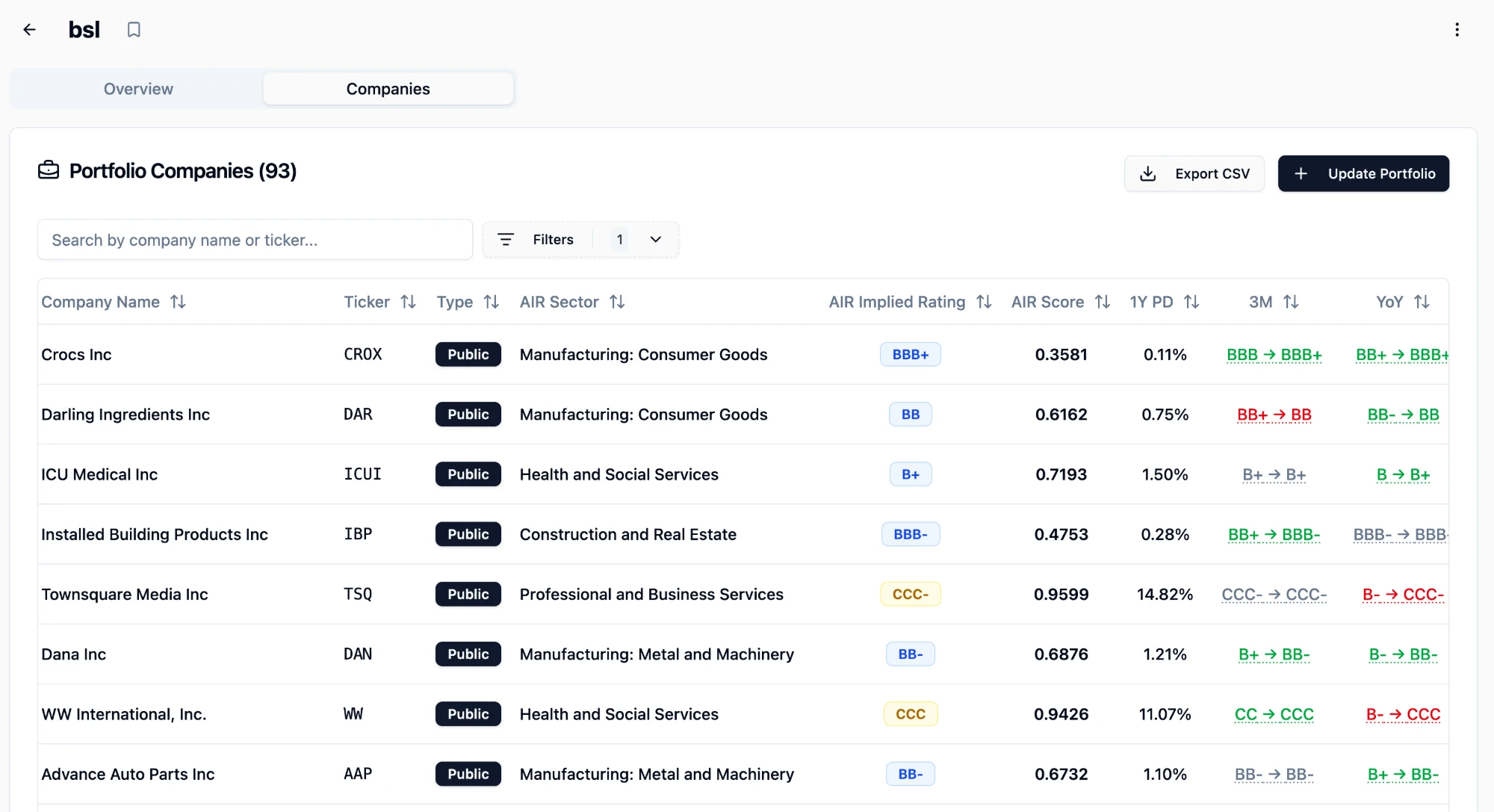
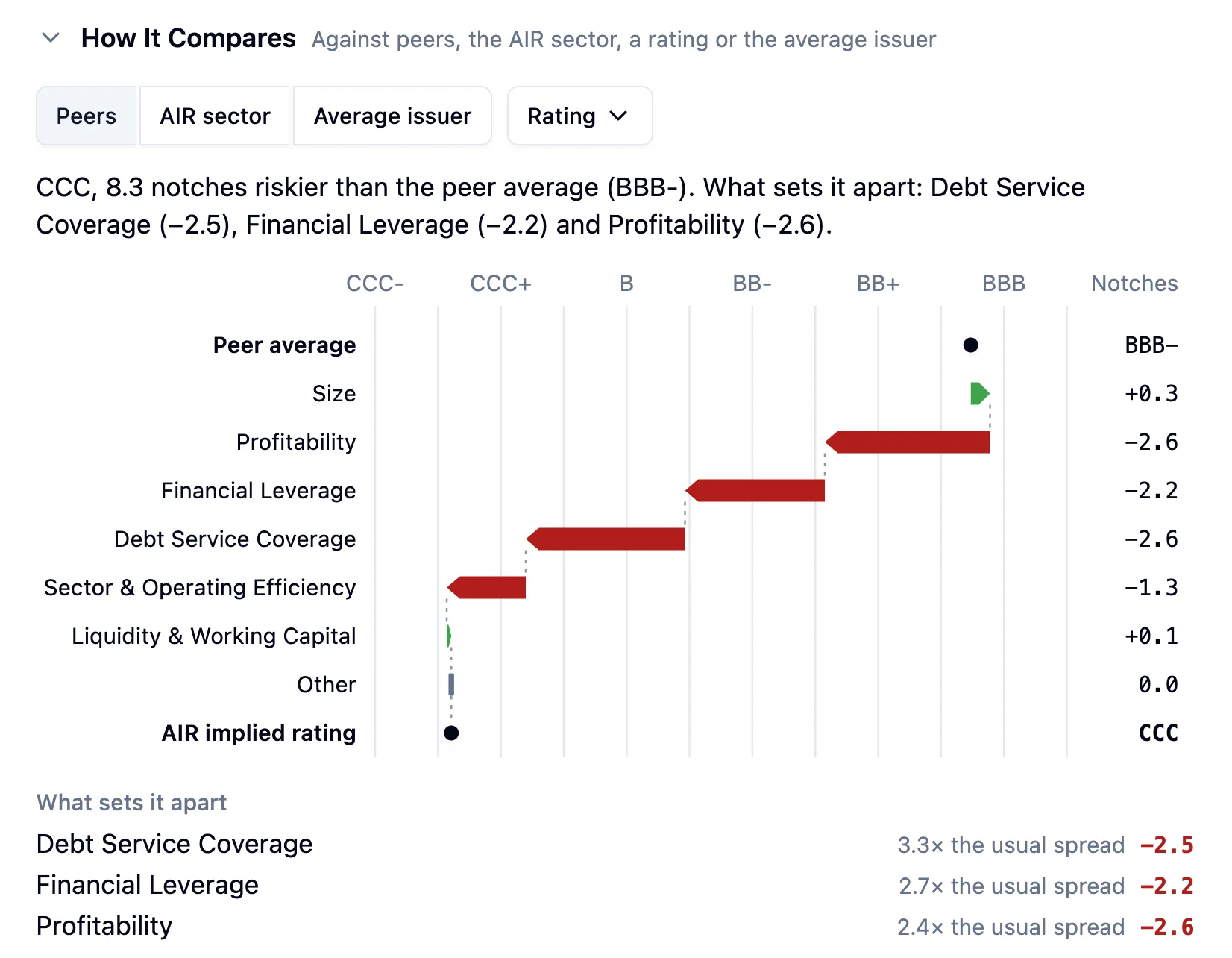
Understand the credit before you commit.
Risk score, implied rating, drivers, and peers, with the inputs and assumptions behind them in view.
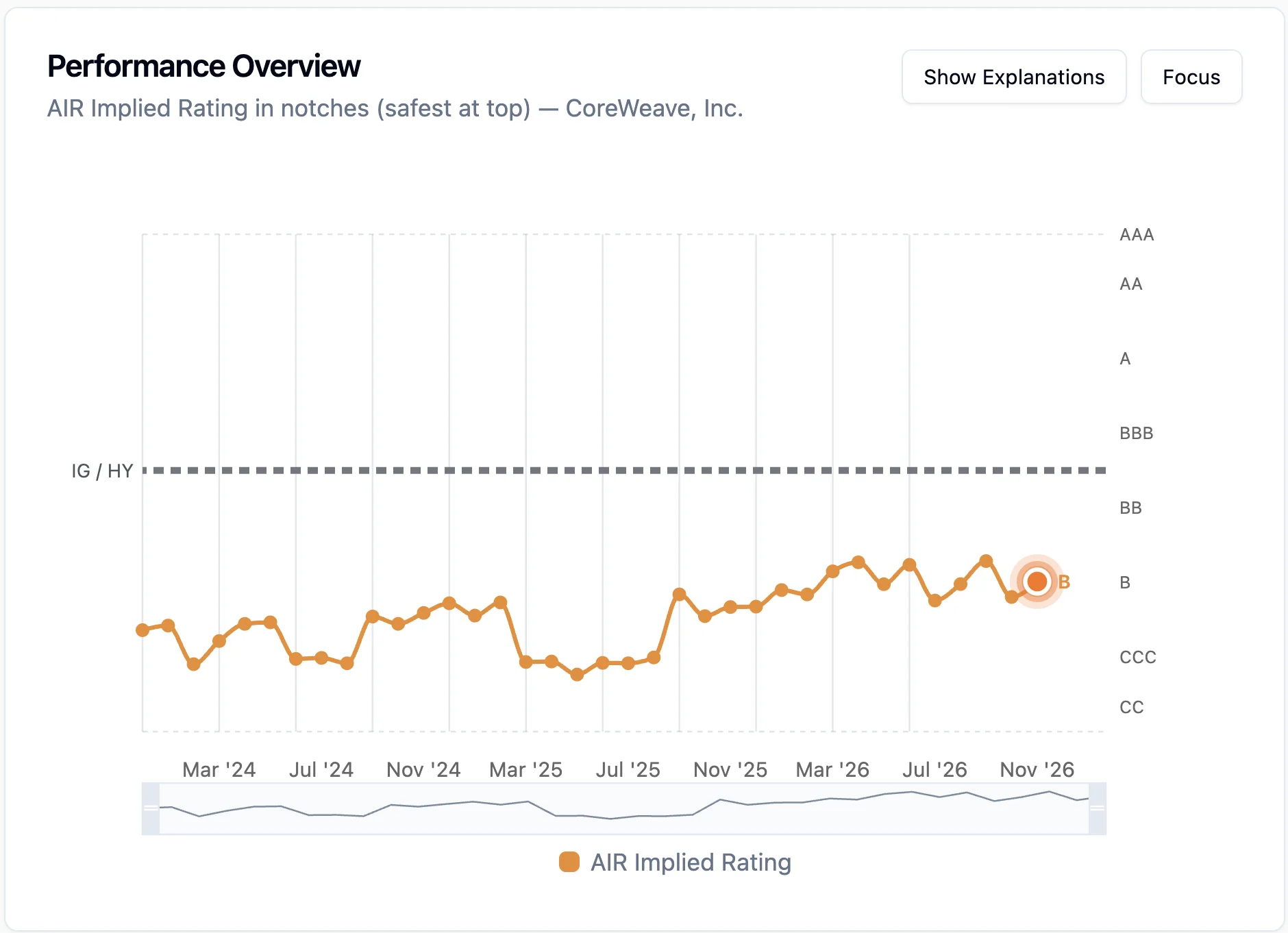
Catch deterioration before prices fall.
Daily credit signals, with alerts on implied rating changes and new financials, and what’s driving each move.
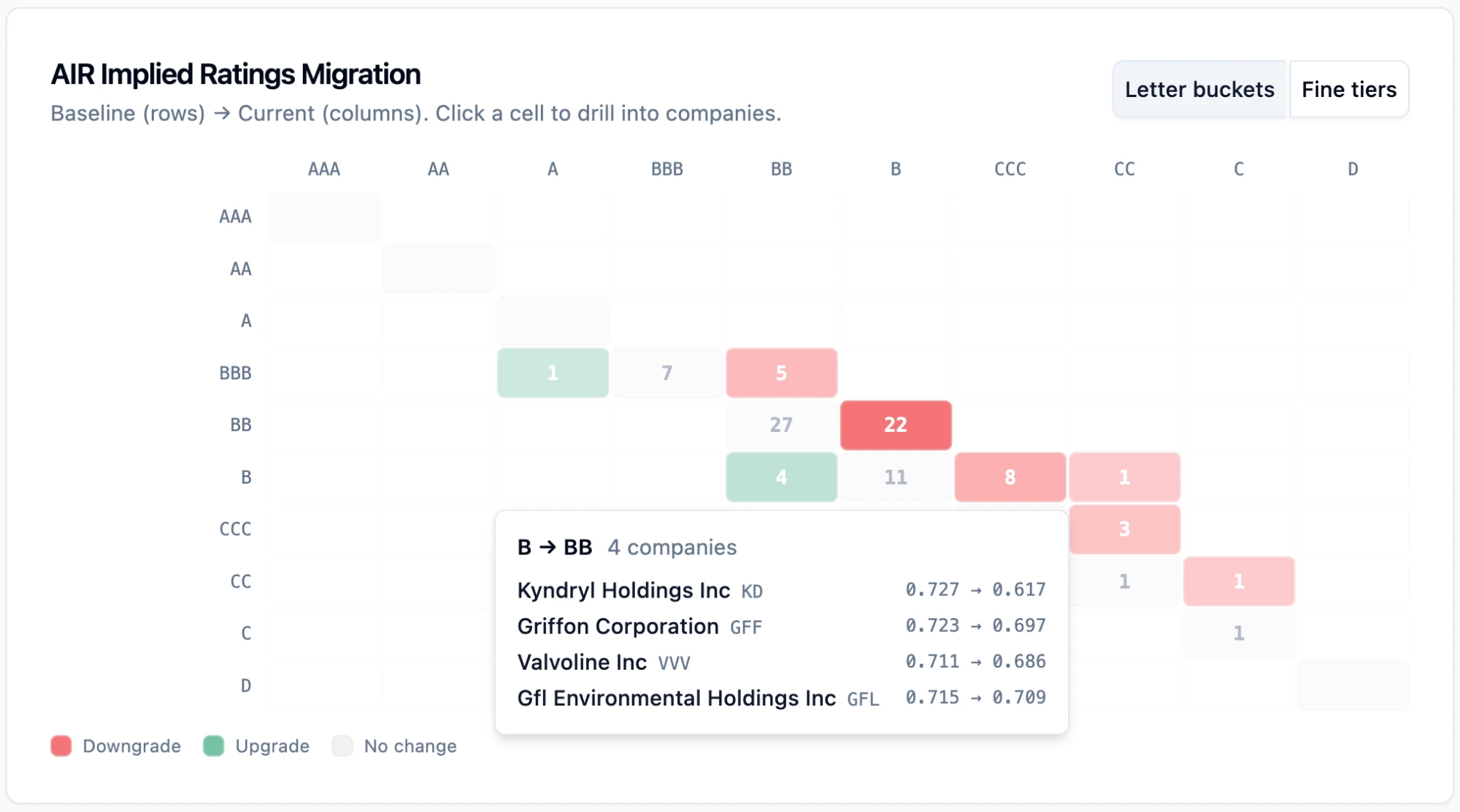
See where a shock could put pressure on your portfolio.
Describe a tariff, a rate move, or a demand slowdown, run it across your portfolio, and see where exposure concentrates.
Credit investment questions, worked through.
Company fundamentals, credit deterioration, and downside scenarios, public and private.
- AIR Research · Credit deterioration
We're Back: The Children's Place Credit Unravels
Read analysison Substack (opens in a new tab) - AIR Research · Private company, estimated financials
AI Giants' Credit Reality Check
Read analysison Substack (opens in a new tab) - AIR Research · Peer comparison
Who Survives the Neocloud Shakeout?
Read analysison Substack (opens in a new tab)
What credit investment teams ask us.
Why not rely on agency ratings?
By the time an agency downgrades, the bonds and loans have usually repriced. AIR flags deterioration about 11 months ahead of agency downgrades and up to 6 months ahead of bond and loan price collapses, including for private issuers with no rating at all.
Can’t we do this with Excel and an AI assistant?
They summarize what already happened. AIR’s deterministic models are trained to flag deterioration before it happens, give the same answer every time, and run one scenario across all your holdings in minutes. Language models research and explain; they never set the implied rating. Read more in Why LLMs Should Not Make Credit Decisions (opens Substack in a new tab).
How does AIR help find mispriced credit?
Compare AIR’s implied rating with the agency rating. Where they diverge, AIR shows the drivers behind the gap, so your team can see which names may be rated, and priced, too generously or too harshly. AIR’s implied rating is also a leading indicator for bond and loan prices, so the gap can show before the market reprices the name.
Can AIR assess private companies with limited financials?
Yes, on the same basis as rated issuers. Upload the financials you have, in PDF, Excel, or Bloomberg and Octus/Findox exports, or let Financials Builder estimate missing inputs. Every figure is labeled, adjustable, and traceable.
Can we use our own credit model?
Yes, your team can bring its credit model into AIR and run it alongside AIR’s.
How does AIR protect our data?
AIR is SOC 2 Type II. Customer data is segregated by tenant and is not used to train AIR’s models. Security controls and supporting documentation are available for your team’s review. Trust & Security.
See the names you cover in AIR.
Share a few issuers you hold or are evaluating, public or private, and AIR's team will walk you through their assessments, credit drivers, and scenarios.